- Projekt LIFE ARTEMIS
- Slovenski gozdovi
- Tujerodne vrste
- Vplivi
- Vplivi na biotsko raznovrstnost
- Vplivi na gospodarstvo
- Vplivi na zdravje ljudi
- Ukrepi
- Pretekli projekti
Projekt LIFE ARTEMIS – Osveščanje, usposabljanje
in ukrepanje za invazivne tujerodne vrste v gozdu
Home > Alien species in Slovenia > Alien plants > Cape ivy


NATIVE RANGE: South Africa
FIRST FINDING IN SLOVENIA: not yet found in Slovenia
PATHWAYS: horticulture
POSSIBLE TO FIND: year-round
FLOWERING SEASON: October-March (in winter!)
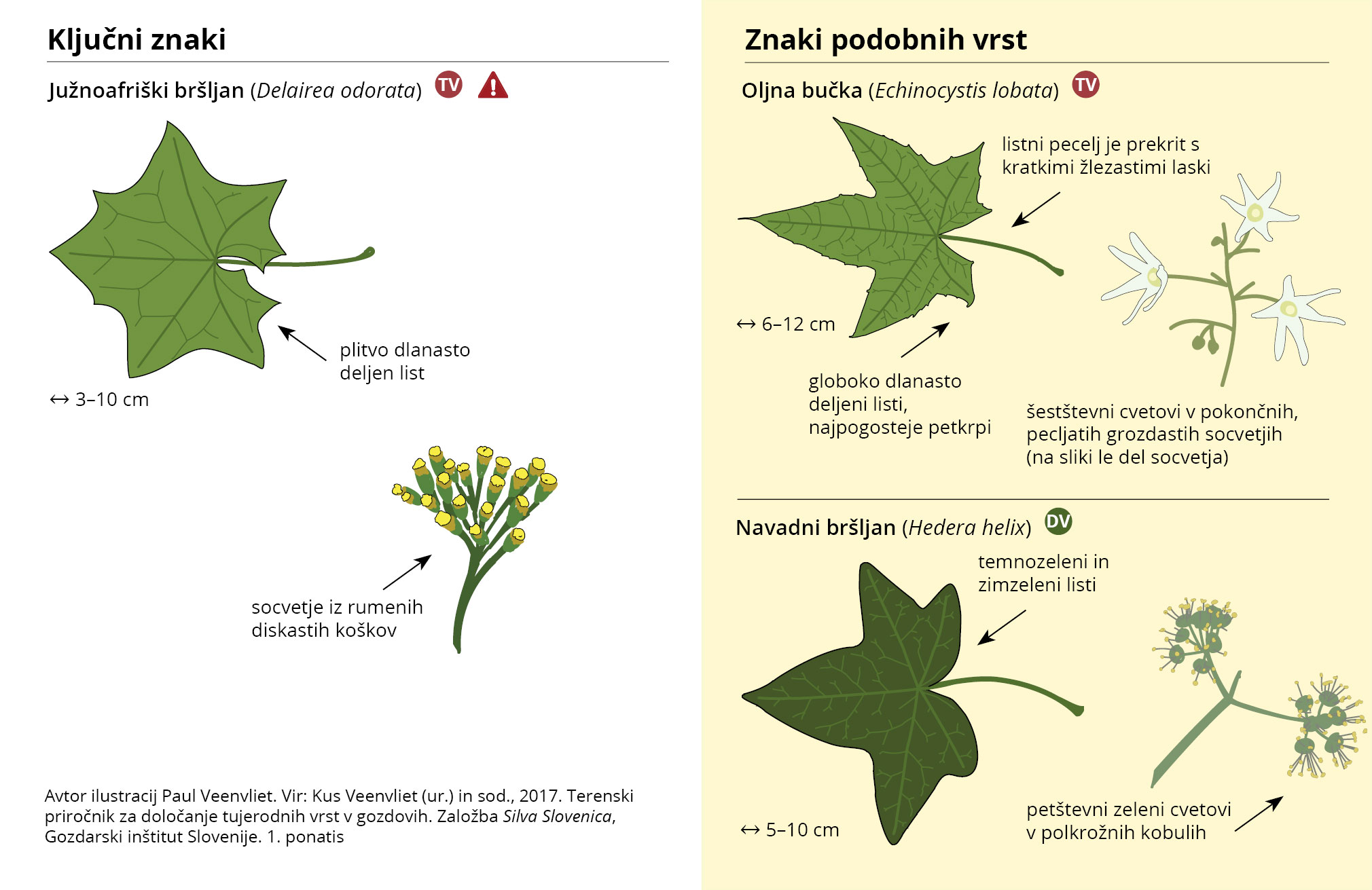
DESCRIPTION: Perennial herbaceous vine with a woody rootstock. Deciduous, in milder climate evergreen. Stems fleshy, glabrous, often purple when young, later green and eventually creamy-brown. Leaves spiralling, palmately compound, glossy and fleshy. Petioles are longer than the lamina. Usually, there is a pair of flattened, kidney-shaped stipules at the base of the petioles. Flower heads are borne in dense clusters. Flowers consist solely of disc florets, surrounded by small green bracts with ray florets absent. Flowers during winter and early spring. Fruits are reddish-brown achenes, 2 mm long. Pappus cylindric, 5–6 mm long. The plant has an unpleasant smell.
HABITAT: Within native range grows on humid sites, especially along forest edges and in clearings.
STATUS: Found in Western and Southwestern Europe. Most observations from Spain, Portugal, France, the United Kingdom and Ireland. Not yet found in Slovenia, based on locations in Croatia and Italy it can be expected in the coastal region.
SIMILAR SPECIES: Climbing groundsel (Senecio angulatus), has more fleshy leaves and flowers with ray florets. Wild cucumber (Echinocystis lobata) has similar, but more deeply lobed leaves. Flowers white, fruit is a large pepo with prickles. Ivy (Hedera helix) has darker, evergreen leaves. Its flowers are green and borne in small clusters.
SOURCE: Field Guide to Invasive Alien Species in European Forests