
- Projekt LIFE ARTEMIS
- Slovenski gozdovi
- Tujerodne vrste
- Vplivi
- Vplivi na biotsko raznovrstnost
- Vplivi na gospodarstvo
- Vplivi na zdravje ljudi
- Ukrepi
- Pretekli projekti
Projekt LIFE ARTEMIS – Osveščanje, usposabljanje
in ukrepanje za invazivne tujerodne vrste v gozdu
Home > Alien species in Slovenia > Alien fungi > Dothistroma blight



NATIVE RANGE: North and Central America
FIRST FINDING IN SLOVENIA: 1972
PATHWAYS: Transported with fruits. Spores are secondary spreading with wind and rain.
POSSIBLY TO FIND:
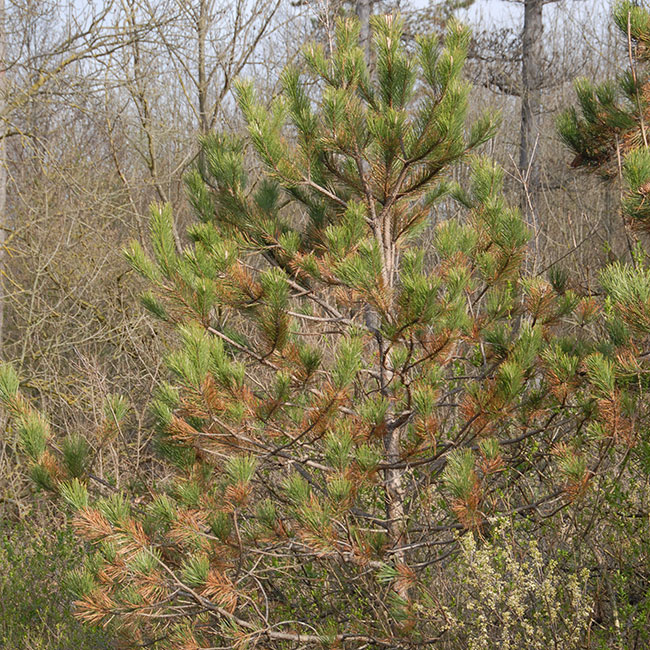
DESCRIPTION: Dothistroma blight is caused by two morphologically indistinguishable species: D. septosporum in D. pini. Both fungi primarily affect pine trees. Red to reddish brown spots and bands appear on the tip of infected needles, followed by tiny black asexual fruiting bodies which break through the surface of the needles. In the end, the entire needles die and are shed prematurely. Needles of lower branches are often affected first. The disease then gradually spreads upwards to the crown and outwards along the branches. After several years of a severe infection, the affected tree may die.
HOST PLANTS: The most susceptible species include black pine (Pinus nigra), mountain pine (P. mugo), stone pine (P. pinea) and Scots pine (P. sylvestris).
STATUS: D. septosporum is locally present throughout Europe whereas D. pini has a more restricted distribution. In Slovenia, this disease has in recent years spread to the Karst region, from where it was not known before. Most affected are pine trees in moist localities.
SIMILAR SPECIES: Brown spot needle blight (Lecanosticta aricola), Cyclaneusma needle-cast (Cyclaneusma minus), Sphaeropsis shoot-killing of pine (Diplodia pinea) and Lophodermium needle cast (Lophodermium seditiosum) are all similar.
SOURCE: Field Guide to Invasive Alien Species in European Forests